
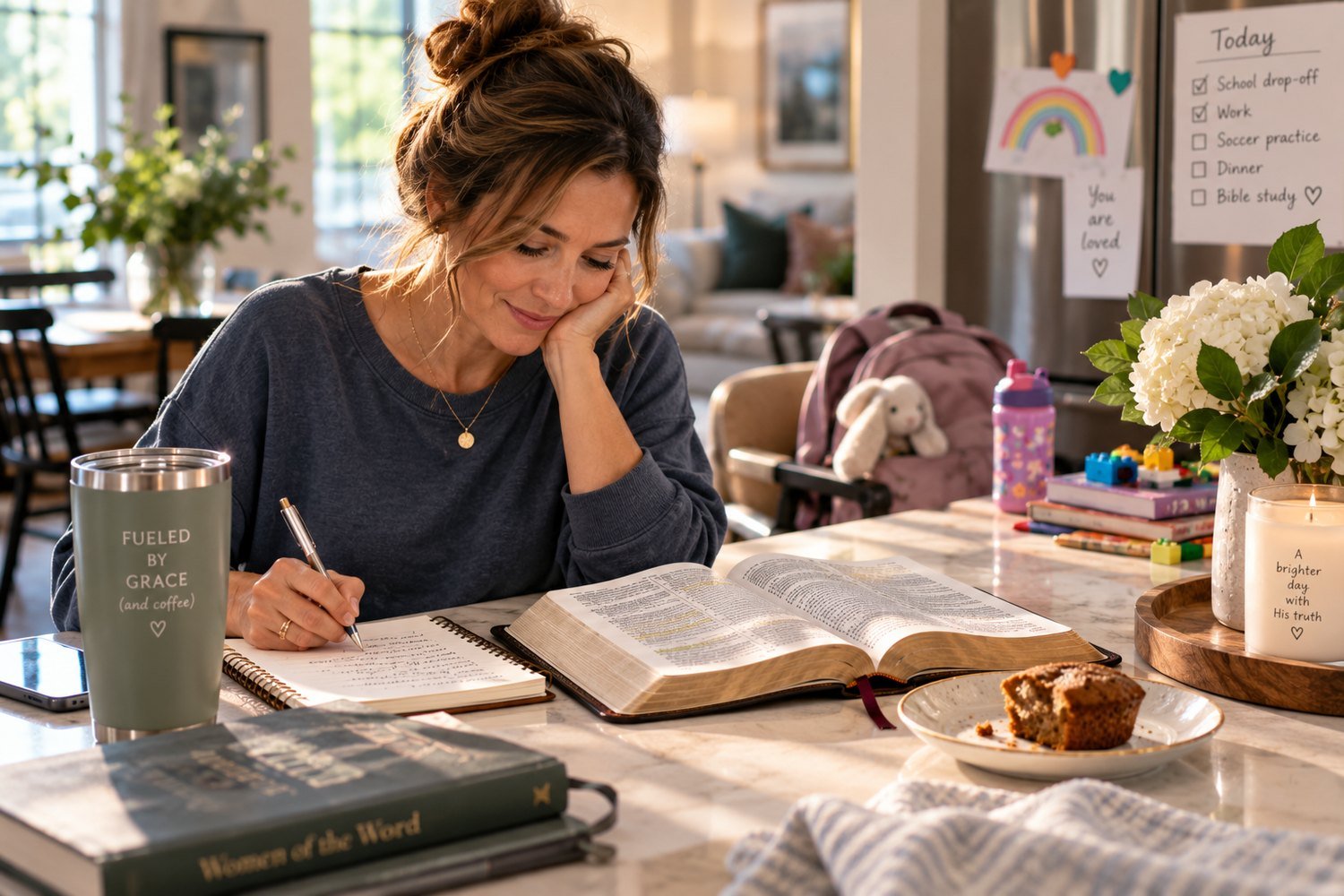
One of the things I hear most often from women is some version of this:
“I want to understand the Bible better. I just don’t know where to start.”
Sometimes that comes from a woman who is new to Scripture. Sometimes it comes from someone who has been in church for decades. She knows the stories, recognizes the verses, has listened to sermons and completed Bible studies, and probably owns more than one Bible. But sitting down with Scripture on her own can still feel a little intimidating.
I understand that.
For a long time, Bible study was something I mostly associated with someone else teaching me. I loved good teachers, and I still do. I am deeply grateful for the people who have helped me understand Scripture more clearly.
But somewhere along the way, I began to realize that learning from good teachers and learning to study the Bible for myself were not competing ideas. I needed both.
And I wanted other women to know they could do both too.
Several years ago, I was working with a small group of younger and newer Christians who wanted to develop the ability to study Scripture for themselves. They did not need another complicated system. They needed something simple enough to remember that would help them slow down, pay attention, ask good questions, and begin learning how to handle the Word with confidence.
That is when I developed a method I call SEEK.
The name came from Jesus’ words in Matthew 7:7:
“Ask, and it will be given to you. Seek, and you will find. Knock, and the door will be opened to you.”
— Matthew 7:7, CSB
I loved the idea of teaching these believers to become seekers—not seekers after something new or hidden, but women who knew how to open the Word God had already given them and look carefully at what He had revealed.
SEEK became a simple way to help them do that.
Before I explain it, though, I want to take some pressure off.
You do not have to study enormous portions of Scripture for God’s Word to work deeply in you. There are seasons when you may have an hour at the kitchen table with your Bible, a notebook, and several resources spread around you. There are other seasons when ten quiet minutes feels like a gift.
God’s Word is accessible in both.
Sometimes one verse may take you several days to fully unpack, and that is perfectly fine. No one says you have to move through every step of SEEK in one sitting. There will also be times when a longer passage opens up naturally and you are able to move through it more quickly. That is part of the beauty of God’s Word: it meets us where we are.
A woman raising small children can open it. A woman caring for aging parents can open it. A woman with a demanding job can open it. A woman in retirement with more margin can open it.
And let’s remember, sisters, God is completely aware of the season we are in. Most of us can step back and recognize that this season—even with its demands—is also a blessing directly from Him. So what better way to receive that blessing than to open His Word and let Him speak life into us through it?
We may have different amounts of time and energy in different seasons, but we are never disqualified from knowing God through His Word because our life does not currently look like someone else’s ideal quiet time.
Sometimes a few verses studied carefully will feed us more than several chapters hurriedly read.
Hebrews 4:12 tells us that “the word of God is living and effective.” We are not trying to manufacture life from the page by accomplishing a certain number of chapters. We are coming to the living Word of the living God and asking Him to help us understand what He has said.
His promise to us is simple and reassuring: if we seek Him, we will find Him. What He asks from us is willingness and perseverance—the determination not to let distraction, discouragement, or the enemy keep us from returning to Him.
And He is faithful to meet us there.
Always.
That makes Bible study feel much less like an assignment to complete and much more like an invitation.
Ezra 7:10 gives us a beautiful picture of that invitation lived out. Scripture tells us that Ezra had “determined in his heart to study the law of the LORD, obey it, and teach its statutes and ordinances in Israel.”
I love the order. Ezra studied God’s Word, obeyed what he learned, and then taught it to others. He did not study merely to collect information. He wanted to understand what God had said and live in response to it.
That is still the goal.
And thankfully, it does not require us to be pastors, seminary graduates, or people who know how to pronounce the Hebrew words and some of those crazy names of places and people.
God has given His Word to His people.
That includes you.
The Bible certainly can be difficult in places. Some passages require patience. Some raise questions. Some need historical or cultural context, and sometimes we need a good teacher or reliable resource to help us understand what we are reading.
But difficult does not mean inaccessible.
You can learn to study the Bible for yourself.
And one of the most important things you can learn is simply to slow down and pay attention.
We sometimes read quickly because we recognize a passage. We skim because we think we already know what it says. Or we immediately ask, “What does this mean for me?” before we have stopped to ask, “What does it mean?”
Those are different questions.
Application matters deeply, but good application grows from good understanding. That is what SEEK is designed to help us do.
S — SEE
First, see what is actually there.
Read the passage at least twice. If writing helps you slow down, write it out. Notice repeated words, mark contrasts, circle names, and pay attention to commands, promises, questions, cause-and-effect statements, or words that connect one thought to another.
You are not trying to be impressive. You are simply looking carefully.
What does the passage actually say?
It is amazing what we begin to notice when we stop assuming we already know.
E — EXPLORE
Next, explore what you are seeing.
What questions does the passage raise? Who is speaking? Who is being addressed? What happened before this? What happens after it? Is there a word you need to understand more clearly? Would some historical or cultural information help?
This is where good resources can serve us well. A study Bible, cross-references, a Bible dictionary, a trustworthy commentary, or another reliable translation may help us see something we missed.
And nowadays, those kinds of resources are readily available, often for free online. One excellent resource is BlueLetterBible.org, and there are many others. Most of us are no longer in a position where a lack of a physical library should greatly limit our ability to dig into God’s Word.
But I want the resource to help me understand Scripture, not replace Scripture. So I begin with the text, and then I invite good teachers and good tools to help me explore it.
E — EXPLAIN
Once you have looked and explored, try to explain what you have learned in your own words.
I often ask, “What is the big message here?”
You do not have to account for every detail in one sentence. But if you cannot explain the main thought simply, that may just mean you need to stay with the passage a little longer.
Sometimes I write something like, “God is showing me that…” or “This passage teaches that…”
Putting the truth into our own words forces us to move beyond recognizing familiar language and toward understanding what it means.
K — KNOW
Finally, ask what you now know and how that truth should shape you.
What have you learned about God? What does the passage reveal about people? Is there something to believe, obey, confess, remember, or practice? Is there a truth you need to carry into the day ahead?
Then pray about what you have learned.
Prayer is not simply the spiritual bow we tie around Bible study when we are finished. The goal was never information alone. We want God’s Word to shape the way we think, respond, worship, choose, love, forgive, wait, and trust.
That is why I love Ezra’s example. He studied God’s Word and then obeyed it. The truth he learned became part of the life he lived.
And that is where Bible study becomes personal in the best possible way.
We are not making Scripture mean whatever we need it to mean that day. We are discovering what God has actually said and then allowing His truth to speak into the life we are actually living.
You do not have to open your Bible every morning and discover something no one else has ever seen. You do not have to produce a theological breakthrough before breakfast. You can simply read carefully, ask good questions, use good resources when you need them, understand the message, and respond to the truth.
Then you do it again.
Over time, passages begin to connect. Themes become familiar. You recognize the character of God more readily and begin to notice when a verse is being used outside its context. You find yourself asking better questions, and your confidence begins to grow.
Not confidence that you will always get everything right.
Confidence that you can open God’s Word and begin.
There will be times when no teacher is sitting beside you. There will be decisions to make, fears to face, questions to wrestle with, and seasons when you desperately need to remember what is true.
In those moments, I want you to know how to return to the Word.
And you will still have questions. I certainly do. There are passages I study and eventually have to say, “Well, Lord, I still have questions about that one.”
Questions do not have to frighten us. Often they are simply an invitation to look more closely, learn a little more, and keep seeking.
So if Bible study has ever felt like something other women somehow learned to do while you missed the lesson, I want you to hear this clearly:
You can learn.
Choose a passage. It does not have to be a long one. Open your Bible and give the words in front of you your attention.
See. Explore. Explain. Know.
Whatever season of life you are in, God’s Word is there. It is living. It is effective. And you are invited to keep seeking Him in it.
You do not have to know everything before you begin.
You just have to begin.