Category: Devotionals

  • Identity in Christ: Where We Begin

    Identity in Christ: Where We Begin

    Don’t you just love it when you join a new group or organization, and on that first night, when you don’t know anyone, they go around the room and ask you to introduce yourself and say something about your life? Those moments are always awkward. How do you summarize yourself in a couple of sentences? How do you share who you really are and what’s important to you in a way that makes other people want to know you better?

    Most of us do the same thing. We talk about what we do for a living, how many children we have, our family, or our husband. We talk about these things because they’re good, we love them, and they matter to us. They’re important gifts from God.

    As uncomfortable as those introductions can be, it’s even more uncomfortable when we begin asking that question of ourselves. We have a setback, a disappointment, or a stretch of time when we just don’t feel like ourselves, and we begin wondering, “Who am I? What difference do I make in the world? Am I accomplishing anything that matters?”

    Those questions can bounce around in our minds even when we recognize, “This isn’t really how I feel about my life. It’s just where my thoughts are going right now.” Sometimes that leads us into comparison. We start thinking about where we aren’t measuring up to other people we know, or to the ideals we have for ourselves.

    We get into trouble when we look to the world to tell us who we are. Our identity is so much more than what the world can see or measure. Even the good things cannot give us complete fulfillment.

    I love my family. I love them so much, and I know you love yours. But even with that love, we can sometimes feel unsure of ourselves. When I was teaching, I knew I was doing meaningful work. There were still days when I wondered whether I was getting through to very many people or whether what I was doing was making a difference.

    Then a season changes. You move from one field of work to another, retire, or watch your children leave home, and the question comes up again: “Now who am I?” When so much of your life has been wrapped up in those responsibilities, it can take some time to figure out what life looks like without them.

    When we start feeling that way, it’s important to push the pause button. As Christians, we have somewhere else to begin this evaluation. Our identity rests in what Jesus has done for us, and understanding that changes how we see everything else.

    But to understand who we are in Christ, we first need to understand what it means to belong to Him. Perhaps you’ve heard people talk about salvation, and you’re not sure whether you have it—or even why you need it. Let’s pause there, because this is where our identity in Christ begins.

    I was only nine years old when I came to know Jesus Christ as my personal Savior. Now, you might wonder how much sin a nine-year-old could even understand. I am very thankful that I came to know Him then, but I understand more now about what was happening in my heart.

    I felt the Holy Spirit drawing me to Jesus, and I felt very sinful. Looking back, I know that wasn’t because I had accumulated so many terrible deeds in nine years. But I shared the sinful nature common to all of us. The weight of sin was on my shoulders, and I recognized my need for Him.

    Romans 3:23–26 helps explain that need. All of us have sinned and fall short of God’s glory. Whatever our age or history, we cannot make ourselves right with God. But this passage also tells us that we are justified freely by His grace through the redemption found in Jesus. To be justified means that God declares us righteous before Him. Jesus provides the forgiveness and freedom from sin that we could never obtain for ourselves.

    That was the good news I was hearing as a little girl. Jesus had come into our world as fully God and fully man. He lived without sin and willingly went to Calvary to bear our sins and offer us redemption. He died and rose again. We have a living Savior who has made a way for us to come to God.

    My sin stood between me and our holy God, and I could not remove it myself. Because of His great love, God sent His Son to make things right. Through Jesus, I could be forgiven and accepted on the basis of His righteousness.

    Romans 5:6–11 tells us that Christ died for us while we were still sinners. God did not wait for us to become worthy of His love. Through the death of His Son, we are reconciled to Him—brought into a relationship with the God from whom our sin had separated us.

    I couldn’t have explained all of that at nine. But I understood that Jesus loved me, and I was really confident that He had come for me. I wanted to receive what He was offering. I called on Him to be my Lord and Savior, and I wanted to follow Him.

    I remember feeling as though a weight had been lifted from my shoulders. I felt free and loved, and I remember the hope that filled my heart.

    Now, your experience may have felt different. The promise of salvation rests on what Jesus has done rather than on whether you felt exactly what I felt. Romans 6:23 tells us that the wages of sin is death, but God’s gift is eternal life in Christ Jesus our Lord. We receive that gift through faith in Him.

    Ephesians 2:1–5 describes our condition apart from Christ as being dead in our sins. That helps me understand why trying harder could never have been enough. I needed the life that only God could give. Because of His great love and mercy, He makes us alive with Christ.

    So what happened that day was much more than a little girl feeling better. God gave me new life. And His saving work reached far beyond the sins of my childhood. He knew every sin that would follow. His sacrifice was sufficient for it all.

    That forgiveness has given me freedom throughout my life. It has also made me want to honor Him. I don’t want to treat lightly the sin He died to redeem me from. I want to live for Him.

    Have I done that perfectly? Certainly not. I haven’t always listened when the Holy Spirit was guiding me. But He has been faithful, and as I look back, I can see His work in my life, patiently making me more like Jesus.

    That is why salvation matters so much to this question of identity. Second Corinthians 5:17 tells us that anyone in Christ is a new creation. When we come to Him, we receive more than a chance to improve ourselves. God gives us a new life.

    And Galatians 4:4–7 tells us that God sent His Son to redeem us so that we could receive adoption as His children. He gives us His Spirit, and we belong to Him as children and heirs.

    Through Jesus, we belong to God. That belonging gives us somewhere to return when the other parts of our lives feel uncertain.

    Your children may leave home, and you may need time to adjust to how much that changes your days. You may retire and miss work that gave you purpose for years. Those changes matter, and knowing Jesus doesn’t mean they won’t be difficult. But they do not change the fact that you are God’s child.

    We still have responsibilities, relationships, and work to do. We still need correction, and we will keep growing. But we can approach those things knowing that we already belong to Him. We don’t have to accomplish enough to earn our place in His family.

    If you’re unsure about salvation, you can come honestly to Jesus, turning from sin and trusting Him to save you. You don’t have to make yourself worthy before you come. You couldn’t do that even if you tried.

    And if you already belong to Him, when that question comes again—“Now who am I?”—pause before you begin counting your accomplishments or comparing your life with someone else’s. Spend some time with what these passages tell you.

    You may still have things to work through about this season of your life. But you can begin knowing that, in Christ, you are a new creation and God’s child. As you ask Him what comes next, you can trust that you belong to Him right here, too.

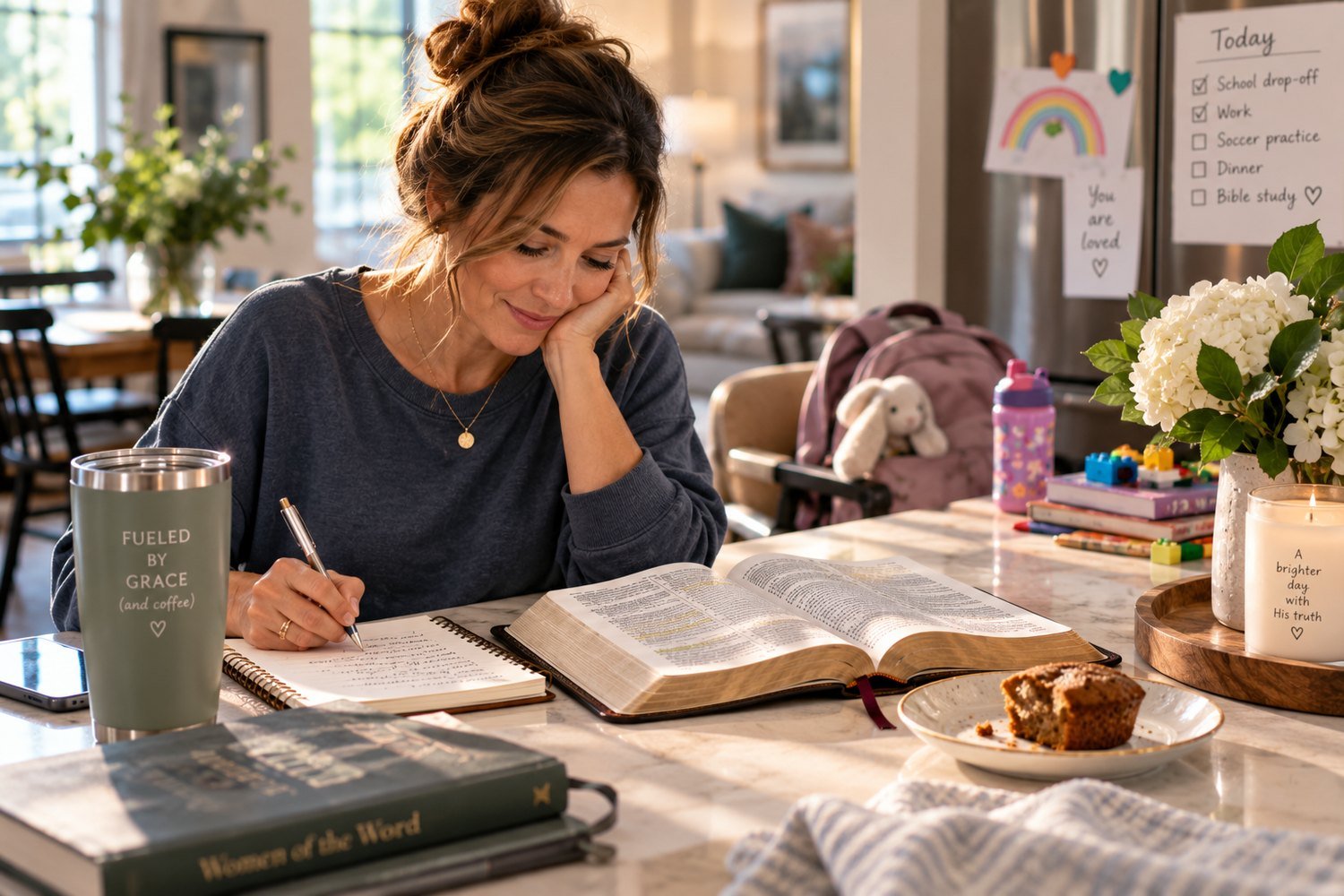
  • From Information to Transformation

    From Information to Transformation

    Have you ever seen one of those videos where someone does the split screen:

    What I think I look like doing this…
    and then
    What I actually look like doing this…

    They always make me laugh because the difference is usually enormous, and unfortunately, I can often identify with the whole principle. I often think I look quite different than I actually do.

    Sometimes that means I give myself more credit than I deserve. I can convince myself that I am more patient, more surrendered, more trusting, or more spiritually mature than I really am.

    But the opposite can happen too. I can be harder on myself than God is. I can focus so much on what still needs work that I fail to recognize the very real evidence of grace and growth He has already produced in me.

    And I think sanctification teaches us to do neither.

    It teaches us to see ourselves truthfully—not better than we are and not worse than we are, but as women who are deeply loved by God, genuinely being changed by Him, and still very much in process.

    That is one of the gifts of Scripture as a mirror. It helps us see clearly.

    James 1:22 says:

    “But be doers of the word and not hearers only, deceiving yourselves.”
    — James 1:22, CSB

    Then he describes someone who looks at himself in a mirror, walks away, and immediately forgets what he looks like.

    That image feels surprisingly current to me because sometimes I think I know what I look like spiritually. I think I am trusting. I think I am abiding. I think I have surrendered that thing. I think I have forgiven. I think I am walking in peace.

    And then Scripture holds up the mirror.

    Not harshly.

    Clearly.

    Sometimes what I see is encouraging. I recognize growth I did not even realize had happened. I can look back and see that something which once sent me into a tailspin no longer has the same hold on me. I can see evidence of the Spirit’s work in places that used to be much harder.

    And sometimes the mirror shows me something else.

    Maybe I am calling something “trust” that is really control with Christian language wrapped around it. Maybe I am saying I have forgiven someone while continuing to rehearse the offense every time their name comes up. Maybe I am telling myself I am waiting on God while quietly trying to force the outcome I want. Maybe I think I am abiding when I am actually just staying very busy doing spiritual things.

    That is where Scripture becomes more than information.

    It becomes an invitation.

    And I think that word matters, because this is where we can get things wrong. We can hear “be doers of the Word” and immediately turn Bible study into another performance project.

    Read the passage. Find the command. Make the list. Do better.

    But that is not the gospel.

    We do not obey so that God will love us. We obey because He already does. We are not earning our place with Him. In Christ, we already belong to Him.

    So when the Word shows us something that needs to change, it is not God standing over us with a clipboard. It is the Father lovingly showing us what is keeping us from greater freedom.

    James later calls God’s Word the “perfect law of freedom.”

    I love that phrase because sometimes we think obedience is restrictive when very often it is the path out of what has been binding us.

    The truth may expose fear, but it also invites trust. It may expose resentment, but it also opens the door to freedom. It may show us our need to control, but then it reminds us who is actually sovereign. It may reveal that we are worn thin from trying to prove something God never asked us to prove.

    And then grace says, “You can stop.”

    That is transformation.

    Not simply knowing more. Not collecting another page of notes. Not becoming the woman who always has the correct answer.

    It is allowing the truth of God to reach the places where we are actually living.

    Romans 12:2 says we are transformed by the renewing of our minds. I used to think of that mostly in terms of learning better thoughts, and of course that is part of it. But the more God changes the way we think, the more He changes the way we live.

    When I believe He is trustworthy, I loosen my grip. When I believe His grace is enough, I stop trying to earn what He has already given. When I believe He is present, I do not have to panic simply because I cannot see the outcome.

    Truth begins to move from the page into the heart, and eventually into ordinary life.

    That process is not instant, and I am very thankful for that.

    God has taught me some truths repeatedly because apparently I needed more than one lesson. There are places where I can look back and see real growth, while in other places I am still very aware that He is not finished with me yet.

    That is sanctification.

    God patiently making us more like Jesus.

    Philippians 2:13 reminds us that “it is God who is working in you both to will and to work according to his good purpose.”

    I find so much rest in that because transformation is not something I have to manufacture. God is already at work.

    My part is not to become obsessed with fixing myself. My part is to stay near Him, to keep opening His Word, to let Him tell me the truth, to agree with Him when He shows me something, and to trust Him enough to respond.

    Sometimes that response may be obvious. Sometimes it may simply be a quiet change in posture—a little less striving and a little more trust, a little less rehearsing and a little more releasing, a little less fear and a little more resting in what God has already said.

    And over time, those little acts of trust begin to shape a life.

    That is why I do not think the goal of Bible study is to finish with a list of things to do. The goal is to know God well enough that His truth begins to change the way we move through the world.

    So maybe the better question after we read Scripture is not simply:

    What did I learn?

    Maybe it is:

    What did God help me see?

    Because sometimes the most loving thing He can do is let us see the difference between what we think we look like spiritually and what is actually going on in our hearts.

    Not to shame us.

    To free us.

    The mirror is not the enemy. It is a gift.

    And when God’s Word shows us the truth, we do not have to scramble to fix everything at once. We can stay with Him, trust His grace, and take whatever faithful step He puts in front of us.

    That is how information becomes transformation.

    And little by little, He makes us more like Jesus.

  • You Can Learn to Study the Bible for Yourself

    One of the things I hear most often from women is some version of this:

    “I want to understand the Bible better. I just don’t know where to start.”

    Sometimes that comes from a woman who is new to Scripture. Sometimes it comes from someone who has been in church for decades. She knows the stories, recognizes the verses, has listened to sermons and completed Bible studies, and probably owns more than one Bible. But sitting down with Scripture on her own can still feel a little intimidating.

    I understand that.

    For a long time, Bible study was something I mostly associated with someone else teaching me. I loved good teachers, and I still do. I am deeply grateful for the people who have helped me understand Scripture more clearly.

    But somewhere along the way, I began to realize that learning from good teachers and learning to study the Bible for myself were not competing ideas. I needed both.

    And I wanted other women to know they could do both too.

    Several years ago, I was working with a small group of younger and newer Christians who wanted to develop the ability to study Scripture for themselves. They did not need another complicated system. They needed something simple enough to remember that would help them slow down, pay attention, ask good questions, and begin learning how to handle the Word with confidence.

    That is when I developed a method I call SEEK.

    The name came from Jesus’ words in Matthew 7:7:

    “Ask, and it will be given to you. Seek, and you will find. Knock, and the door will be opened to you.”
    — Matthew 7:7, CSB

    I loved the idea of teaching these believers to become seekers—not seekers after something new or hidden, but women who knew how to open the Word God had already given them and look carefully at what He had revealed.

    SEEK became a simple way to help them do that.

    Before I explain it, though, I want to take some pressure off.

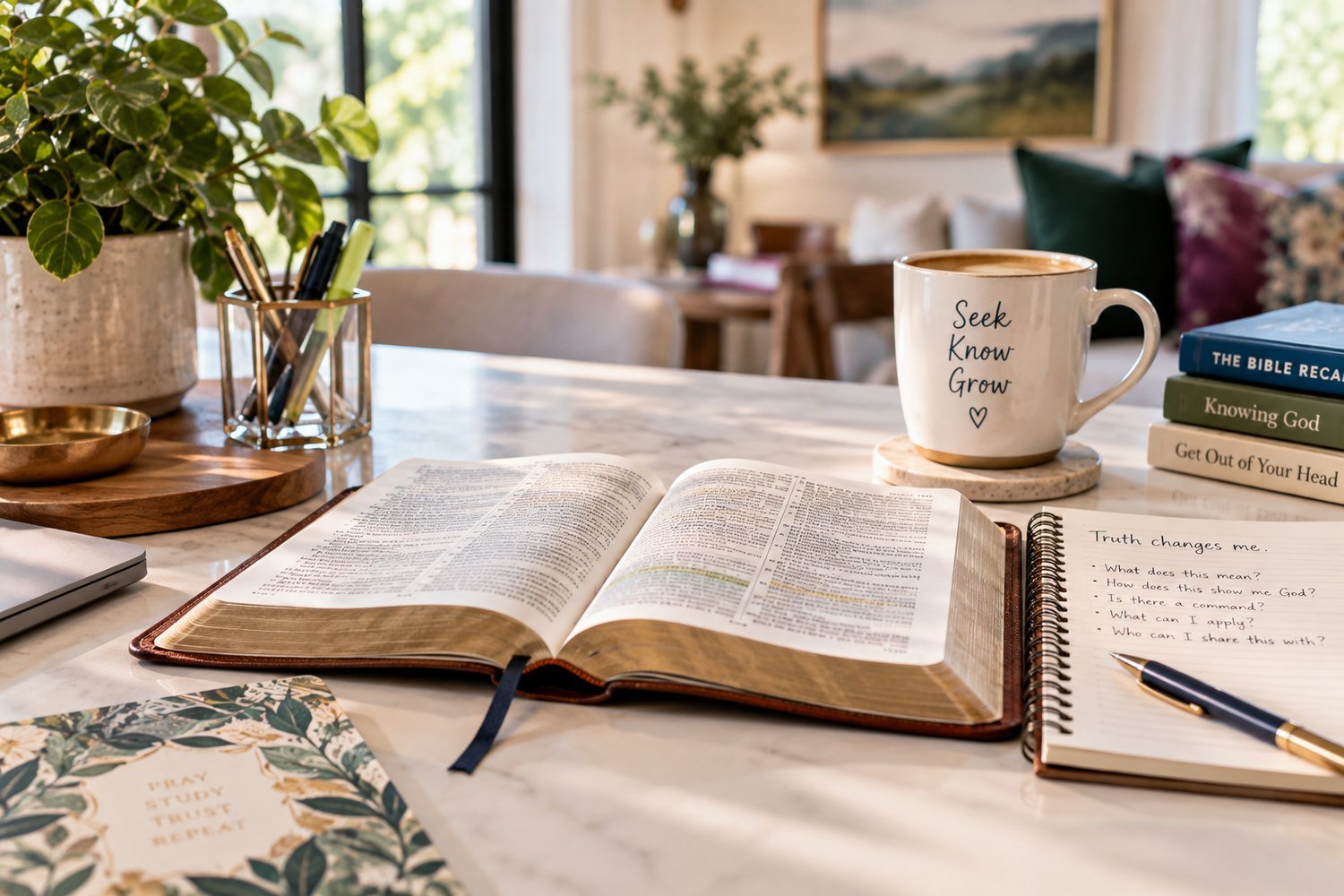
    You do not have to study enormous portions of Scripture for God’s Word to work deeply in you. There are seasons when you may have an hour at the kitchen table with your Bible, a notebook, and several resources spread around you. There are other seasons when ten quiet minutes feels like a gift.

    God’s Word is accessible in both.

    Sometimes one verse may take you several days to fully unpack, and that is perfectly fine. No one says you have to move through every step of SEEK in one sitting. There will also be times when a longer passage opens up naturally and you are able to move through it more quickly. That is part of the beauty of God’s Word: it meets us where we are.

    A woman raising small children can open it. A woman caring for aging parents can open it. A woman with a demanding job can open it. A woman in retirement with more margin can open it.

    And let’s remember, sisters, God is completely aware of the season we are in. Most of us can step back and recognize that this season—even with its demands—is also a blessing directly from Him. So what better way to receive that blessing than to open His Word and let Him speak life into us through it?

    We may have different amounts of time and energy in different seasons, but we are never disqualified from knowing God through His Word because our life does not currently look like someone else’s ideal quiet time.

    Sometimes a few verses studied carefully will feed us more than several chapters hurriedly read.

    Hebrews 4:12 tells us that “the word of God is living and effective.” We are not trying to manufacture life from the page by accomplishing a certain number of chapters. We are coming to the living Word of the living God and asking Him to help us understand what He has said.

    His promise to us is simple and reassuring: if we seek Him, we will find Him. What He asks from us is willingness and perseverance—the determination not to let distraction, discouragement, or the enemy keep us from returning to Him.

    And He is faithful to meet us there.

    Always.

    That makes Bible study feel much less like an assignment to complete and much more like an invitation.

    Ezra 7:10 gives us a beautiful picture of that invitation lived out. Scripture tells us that Ezra had “determined in his heart to study the law of the LORD, obey it, and teach its statutes and ordinances in Israel.”

    I love the order. Ezra studied God’s Word, obeyed what he learned, and then taught it to others. He did not study merely to collect information. He wanted to understand what God had said and live in response to it.

    That is still the goal.

    And thankfully, it does not require us to be pastors, seminary graduates, or people who know how to pronounce the Hebrew words and some of those crazy names of places and people.

    God has given His Word to His people.

    That includes you.

    The Bible certainly can be difficult in places. Some passages require patience. Some raise questions. Some need historical or cultural context, and sometimes we need a good teacher or reliable resource to help us understand what we are reading.

    But difficult does not mean inaccessible.

    You can learn to study the Bible for yourself.

    And one of the most important things you can learn is simply to slow down and pay attention.

    We sometimes read quickly because we recognize a passage. We skim because we think we already know what it says. Or we immediately ask, “What does this mean for me?” before we have stopped to ask, “What does it mean?”

    Those are different questions.

    Application matters deeply, but good application grows from good understanding. That is what SEEK is designed to help us do.

    S — SEE

    First, see what is actually there.

    Read the passage at least twice. If writing helps you slow down, write it out. Notice repeated words, mark contrasts, circle names, and pay attention to commands, promises, questions, cause-and-effect statements, or words that connect one thought to another.

    You are not trying to be impressive. You are simply looking carefully.

    What does the passage actually say?

    It is amazing what we begin to notice when we stop assuming we already know.

    E — EXPLORE

    Next, explore what you are seeing.

    What questions does the passage raise? Who is speaking? Who is being addressed? What happened before this? What happens after it? Is there a word you need to understand more clearly? Would some historical or cultural information help?

    This is where good resources can serve us well. A study Bible, cross-references, a Bible dictionary, a trustworthy commentary, or another reliable translation may help us see something we missed.

    And nowadays, those kinds of resources are readily available, often for free online. One excellent resource is BlueLetterBible.org, and there are many others. Most of us are no longer in a position where a lack of a physical library should greatly limit our ability to dig into God’s Word.

    But I want the resource to help me understand Scripture, not replace Scripture. So I begin with the text, and then I invite good teachers and good tools to help me explore it.

    E — EXPLAIN

    Once you have looked and explored, try to explain what you have learned in your own words.

    I often ask, “What is the big message here?”

    You do not have to account for every detail in one sentence. But if you cannot explain the main thought simply, that may just mean you need to stay with the passage a little longer.

    Sometimes I write something like, “God is showing me that…” or “This passage teaches that…”

    Putting the truth into our own words forces us to move beyond recognizing familiar language and toward understanding what it means.

    K — KNOW

    Finally, ask what you now know and how that truth should shape you.

    What have you learned about God? What does the passage reveal about people? Is there something to believe, obey, confess, remember, or practice? Is there a truth you need to carry into the day ahead?

    Then pray about what you have learned.

    Prayer is not simply the spiritual bow we tie around Bible study when we are finished. The goal was never information alone. We want God’s Word to shape the way we think, respond, worship, choose, love, forgive, wait, and trust.

    That is why I love Ezra’s example. He studied God’s Word and then obeyed it. The truth he learned became part of the life he lived.

    And that is where Bible study becomes personal in the best possible way.

    We are not making Scripture mean whatever we need it to mean that day. We are discovering what God has actually said and then allowing His truth to speak into the life we are actually living.

    You do not have to open your Bible every morning and discover something no one else has ever seen. You do not have to produce a theological breakthrough before breakfast. You can simply read carefully, ask good questions, use good resources when you need them, understand the message, and respond to the truth.

    Then you do it again.

    Over time, passages begin to connect. Themes become familiar. You recognize the character of God more readily and begin to notice when a verse is being used outside its context. You find yourself asking better questions, and your confidence begins to grow.

    Not confidence that you will always get everything right.

    Confidence that you can open God’s Word and begin.

    There will be times when no teacher is sitting beside you. There will be decisions to make, fears to face, questions to wrestle with, and seasons when you desperately need to remember what is true.

    In those moments, I want you to know how to return to the Word.

    And you will still have questions. I certainly do. There are passages I study and eventually have to say, “Well, Lord, I still have questions about that one.”

    Questions do not have to frighten us. Often they are simply an invitation to look more closely, learn a little more, and keep seeking.

    So if Bible study has ever felt like something other women somehow learned to do while you missed the lesson, I want you to hear this clearly:

    You can learn.

    Choose a passage. It does not have to be a long one. Open your Bible and give the words in front of you your attention.

    See. Explore. Explain. Know.

    Whatever season of life you are in, God’s Word is there. It is living. It is effective. And you are invited to keep seeking Him in it.

    You do not have to know everything before you begin.

    You just have to begin.

  • You Can Learn to Study the Bible for Yourself

    You Can Learn to Study the Bible for Yourself

    One of the things I hear most often from women is some version of this:

    “I want to understand the Bible better. I just don’t know where to start.”

    Sometimes that comes from a woman who is new to Scripture. Sometimes it comes from someone who has been in church for decades. She knows the stories, recognizes the verses, has listened to sermons and completed Bible studies, and probably owns more than one Bible. But sitting down with Scripture on her own can still feel a little intimidating.

    I understand that.

    For a long time, Bible study was something I mostly associated with someone else teaching me. I loved good teachers, and I still do. I am deeply grateful for the people who have helped me understand Scripture more clearly.

    But somewhere along the way, I began to realize that learning from good teachers and learning to study the Bible for myself were not competing ideas. I needed both.

    And I wanted other women to know they could do both too.

    Several years ago, I was working with a small group of younger and newer Christians who wanted to develop the ability to study Scripture for themselves. They did not need another complicated system. They needed something simple enough to remember that would help them slow down, pay attention, ask good questions, and begin learning how to handle the Word with confidence.

    That is when I developed a method I call SEEK.

    The name came from Jesus’ words in Matthew 7:7:

    “Ask, and it will be given to you. Seek, and you will find. Knock, and the door will be opened to you.”

    — Matthew 7:7, CSB

    I loved the idea of teaching these believers to become seekers—not seekers after something new or hidden, but women who knew how to open the Word God had already given them and look carefully at what He had revealed.

    SEEK became a simple way to help them do that.

    Before I explain it, though, I want to take some pressure off.

    You do not have to study enormous portions of Scripture for God’s Word to work deeply in you. There are seasons when you may have an hour at the kitchen table with your Bible, a notebook, and several resources spread around you. There are other seasons when ten quiet minutes feels like a gift.

    God’s Word is accessible in both.

    Sometimes one verse may take you several days to fully unpack, and that is perfectly fine. No one says you have to move through every step of SEEK in one sitting. There will also be times when a longer passage opens up naturally and you are able to move through it more quickly. That is part of the beauty of God’s Word: it meets us where we are.

    A woman raising small children can open it. A woman caring for aging parents can open it. A woman with a demanding job can open it. A woman in retirement with more margin can open it.

    And let’s remember, sisters, God is completely aware of the season we are in. Most of us can step back and recognize that this season—even with its demands—is also a blessing directly from Him. So what better way to receive that blessing than to open His Word and let Him speak life into us through it?

    We may have different amounts of time and energy in different seasons, but we are never disqualified from knowing God through His Word because our life does not currently look like someone else’s ideal quiet time.

    Sometimes a few verses studied carefully will feed us more than several chapters hurriedly read.

    Hebrews 4:12 tells us that “the word of God is living and effective.” We are not trying to manufacture life from the page by accomplishing a certain number of chapters. We are coming to the living Word of the living God and asking Him to help us understand what He has said.

    His promise to us is simple and reassuring: if we seek Him, we will find Him. What He asks from us is willingness and perseverance—the determination not to let distraction, discouragement, or the enemy keep us from returning to Him.

    And He is faithful to meet us there.

    Always.

    That makes Bible study feel much less like an assignment to complete and much more like an invitation.

    Ezra 7:10 gives us a beautiful picture of that invitation lived out. Scripture tells us that Ezra had “determined in his heart to study the law of the LORD, obey it, and teach its statutes and ordinances in Israel.”

    I love the order. Ezra studied God’s Word, obeyed what he learned, and then taught it to others. He did not study merely to collect information. He wanted to understand what God had said and live in response to it.

    That is still the goal.

    And thankfully, it does not require us to be pastors, seminary graduates, or people who know how to pronounce the Hebrew words and some of those crazy names of places and people.

    God has given His Word to His people.

    That includes you.

    The Bible certainly can be difficult in places. Some passages require patience. Some raise questions. Some need historical or cultural context, and sometimes we need a good teacher or reliable resource to help us understand what we are reading.

    But difficult does not mean inaccessible.

    You can learn to study the Bible for yourself.

    And one of the most important things you can learn is simply to slow down and pay attention.

    We sometimes read quickly because we recognize a passage. We skim because we think we already know what it says. Or we immediately ask, “What does this mean for me?” before we have stopped to ask, “What does it mean?”

    Those are different questions.

    Application matters deeply, but good application grows from good understanding. That is what SEEK is designed to help us do.

    S — SEE

    First, see what is actually there.

    Read the passage at least twice. If writing helps you slow down, write it out. Notice repeated words, mark contrasts, circle names, and pay attention to commands, promises, questions, cause-and-effect statements, or words that connect one thought to another.

    You are not trying to be impressive. You are simply looking carefully.

    What does the passage actually say?

    It is amazing what we begin to notice when we stop assuming we already know.

    E — EXPLORE

    Next, explore what you are seeing.

    What questions does the passage raise? Who is speaking? Who is being addressed? What happened before this? What happens after it? Is there a word you need to understand more clearly? Would some historical or cultural information help?

    This is where good resources can serve us well. A study Bible, cross-references, a Bible dictionary, a trustworthy commentary, or another reliable translation may help us see something we missed.

    And nowadays, those kinds of resources are readily available, often for free online. One excellent resource is BlueLetterBible.org, and there are many others. Most of us are no longer in a position where a lack of a physical library should greatly limit our ability to dig into God’s Word.

    But I want the resource to help me understand Scripture, not replace Scripture. So I begin with the text, and then I invite good teachers and good tools to help me explore it.

    E — EXPLAIN

    Once you have looked and explored, try to explain what you have learned in your own words.

    I often ask, “What is the big message here?”

    You do not have to account for every detail in one sentence. But if you cannot explain the main thought simply, that may just mean you need to stay with the passage a little longer.

    Sometimes I write something like, “God is showing me that…” or “This passage teaches that…”

    Putting the truth into our own words forces us to move beyond recognizing familiar language and toward understanding what it means.

    K — KNOW

    Finally, ask what you now know and how that truth should shape you.

    What have you learned about God? What does the passage reveal about people? Is there something to believe, obey, confess, remember, or practice? Is there a truth you need to carry into the day ahead?

    Then pray about what you have learned.

    Prayer is not simply the spiritual bow we tie around Bible study when we are finished. The goal was never information alone. We want God’s Word to shape the way we think, respond, worship, choose, love, forgive, wait, and trust.

    That is why I love Ezra’s example. He studied God’s Word and then obeyed it. The truth he learned became part of the life he lived.

    And that is where Bible study becomes personal in the best possible way.

    We are not making Scripture mean whatever we need it to mean that day. We are discovering what God has actually said and then allowing His truth to speak into the life we are actually living.

    You do not have to open your Bible every morning and discover something no one else has ever seen. You do not have to produce a theological breakthrough before breakfast. You can simply read carefully, ask good questions, use good resources when you need them, understand the message, and respond to the truth.

    Then you do it again.

    Over time, passages begin to connect. Themes become familiar. You recognize the character of God more readily and begin to notice when a verse is being used outside its context. You find yourself asking better questions, and your confidence begins to grow.

    Not confidence that you will always get everything right.

    Confidence that you can open God’s Word and begin.

    There will be times when no teacher is sitting beside you. There will be decisions to make, fears to face, questions to wrestle with, and seasons when you desperately need to remember what is true.

    In those moments, I want you to know how to return to the Word.

    And you will still have questions. I certainly do. There are passages I study and eventually have to say, “Well, Lord, I still have questions about that one.”

    Questions do not have to frighten us. Often they are simply an invitation to look more closely, learn a little more, and keep seeking.

    So if Bible study has ever felt like something other women somehow learned to do while you missed the lesson, I want you to hear this clearly:

    You can learn.

    Choose a passage. It does not have to be a long one. Open your Bible and give the words in front of you your attention.

    See. Explore. Explain. Know.

    Whatever season of life you are in, God’s Word is there. It is living. It is effective. And you are invited to keep seeking Him in it.

    You do not have to know everything before you begin.

    You just have to begin.

  • Faith Is Not the Opposite of Thinking

    Many people in the world assume Christians simply inherit their faith. They imagine that people become Christians because someone told them they were when they were children, and that Christianity is really just a collection of comforting ideas we continue believing because they make us feel better.

    Sometimes that picture of Christianity includes phrases such as, “God helps those who help themselves,” or, “God won’t give you more than you can handle,” as though Christians simply collect reassuring sayings, call them Scripture, and never stop to ask whether they are actually true.

    That may be what some people think faith looks like, but that is not what we are doing here. You would not be here if you were not interested in truth. You would not be opening God’s Word, studying it, asking questions, and wanting to understand what He has actually revealed if Christianity were simply a fairy tale you had decided to preserve.

    Our faith is not afraid of truth. It is rooted in truth. And yet, even knowing that, I wonder whether we sometimes fail to lean into our intellect in a way that truly honors God.

    A few years ago, I started paying closer attention to the things I believed. I became much more conscientious about reading often-quoted passages in their actual context instead of assuming I understood them simply because I had heard them all my life.

    I also began noticing that some things I had thought of as Christian “beliefs” were really restrictions or expectations that well-meaning Christians had elevated to the level of doctrine, even though Scripture itself did not. That distinction mattered to me.

    If I am going to say, “The Bible teaches this,” I want to be sure the Bible actually teaches it. And if something is wisdom, tradition, preference, or a particular interpretation, I want to be honest enough to call it that too.

    The more carefully I began looking, the more convinced I became that serious faith does not require us to turn off our minds. Quite the opposite. God gave us minds, and learning to use them under the authority of His Word is part of growing up in our faith.

    That is why Ephesians 4:14–15 is so important to me. Paul writes that believers are not to remain like children, “tossed by the waves and blown around by every wind of teaching.” Instead, we are to grow into Christ, learning to speak the truth in love.

    That picture feels especially vivid now. We live in a world full of headlines, clips, sound bites, algorithms, outrage, fear, certainty, and very persuasive people saying completely contradictory things. There is no shortage of voices telling us what to think, which raises an important question: How do we grow into women who know what is true?

    Part of the answer is learning the difference between childlike faith and childish thinking. Childlike faith says, “Father, I trust You.” Childish thinking says, “I do not need to examine what I hear.”

    Scripture never asks us to stop thinking. It calls us to bring our thinking under God’s authority. Romans 12:2 tells us that transformation comes through the renewing of our minds, and 2 Corinthians 10:5 tells us to take thoughts captive and make them obedient to Christ. In other words, what we think matters because ideas eventually show up in how we live. They shape our fears, our relationships, our decisions, our worship, and our obedience.

    That means discernment is not reserved for pastors, theologians, or naturally analytical people. It is part of Christian maturity, and I hope that feels encouraging rather than intimidating. You do not have to know everything, become a scholar, or be afraid of asking questions. You simply keep coming back to the Word with a willing heart and a teachable mind. That is where discernment begins.

    Of course, discernment can go wrong too. It can become suspiciousness or arrogance, and we can become very good at examining everyone else’s beliefs while never considering the possibility that we may need correction ourselves.

    Biblical discernment has a different posture. It sounds more like, “Lord, show me what is true,” and sometimes, “Lord, show me where I am wrong.”

    I like being right. I especially like discovering that Scripture agrees with something I already believe. It is considerably less comfortable when God’s Word exposes an opinion I have held too tightly. But if Scripture is truly our authority, then it must be allowed to correct us as well as comfort us, and that correction is not something to fear. It is one of the ways God lovingly shapes us.

    Over time, we begin to ask better questions:

    What does Scripture actually say?
    Am I reading this passage in context?
    Have I confused something familiar with something biblical?
    Am I treating a preference as doctrine?
    Am I willing to let God’s Word change my mind?

    Those are not questions of unbelief. They are questions of discipleship.

    First Peter 3:15 tells believers to be ready to give a reason for the hope within us, and then tells us to do it with gentleness and respect. I love that combination because truth and humility belong together.

    I am not responsible for forcing someone else to believe what I believe. I am responsible to know why I believe it, to handle Scripture faithfully, to remain teachable, and to speak with grace.

    Faith is not the opposite of thinking. It is learning to think under God’s authority. And that is not a reprimand to know more; it is an invitation to keep going deeper.

    So keep opening your Bible, asking questions, learning context, listening to good teachers, and allowing Scripture to strengthen what is true and correct what is not. The goal is not to become the woman who always has the right answer.

    The goal is to become the woman who keeps returning to the One who does.

  • Faith Is Not the Opposite of Thinking

    Faith Is Not the Opposite of Thinking

    Many people in the world assume Christians simply inherit their faith. They imagine that people become Christians because someone told them they were when they were children, and that Christianity is really just a collection of comforting ideas we continue believing because they make us feel better.

    Sometimes that picture of Christianity includes phrases such as, “God helps those who help themselves,” or, “God won’t give you more than you can handle,” as though Christians simply collect reassuring sayings, call them Scripture, and never stop to ask whether they are actually true.

    That may be what some people think faith looks like, but that is not what we are doing here. You would not be here if you were not interested in truth. You would not be opening God’s Word, studying it, asking questions, and wanting to understand what He has actually revealed if Christianity were simply a fairy tale you had decided to preserve.

    Our faith is not afraid of truth. It is rooted in truth. And yet, even knowing that, I wonder whether we sometimes fail to lean into our intellect in a way that truly honors God.

    A few years ago, I started paying closer attention to the things I believed. I became much more conscientious about reading often-quoted passages in their actual context instead of assuming I understood them simply because I had heard them all my life.

    I also began noticing that some things I had thought of as Christian “beliefs” were really restrictions or expectations that well-meaning Christians had elevated to the level of doctrine, even though Scripture itself did not. That distinction mattered to me.

    If I am going to say, “The Bible teaches this,” I want to be sure the Bible actually teaches it. And if something is wisdom, tradition, preference, or a particular interpretation, I want to be honest enough to call it that too.

    The more carefully I began looking, the more convinced I became that serious faith does not require us to turn off our minds. Quite the opposite. God gave us minds, and learning to use them under the authority of His Word is part of growing up in our faith.

    That is why Ephesians 4:14–15 is so important to me. Paul writes that believers are not to remain like children, “tossed by the waves and blown around by every wind of teaching.” Instead, we are to grow into Christ, learning to speak the truth in love.

    That picture feels especially vivid now. We live in a world full of headlines, clips, sound bites, algorithms, outrage, fear, certainty, and very persuasive people saying completely contradictory things. There is no shortage of voices telling us what to think, which raises an important question: How do we grow into women who know what is true?

    Part of the answer is learning the difference between childlike faith and childish thinking. Childlike faith says, “Father, I trust You.” Childish thinking says, “I do not need to examine what I hear.”

    Scripture never asks us to stop thinking. It calls us to bring our thinking under God’s authority. Romans 12:2 tells us that transformation comes through the renewing of our minds, and 2 Corinthians 10:5 tells us to take thoughts captive and make them obedient to Christ. In other words, what we think matters because ideas eventually show up in how we live. They shape our fears, our relationships, our decisions, our worship, and our obedience.

    That means discernment is not reserved for pastors, theologians, or naturally analytical people. It is part of Christian maturity, and I hope that feels encouraging rather than intimidating. You do not have to know everything, become a scholar, or be afraid of asking questions. You simply keep coming back to the Word with a willing heart and a teachable mind. That is where discernment begins.

    Of course, discernment can go wrong too. It can become suspiciousness or arrogance, and we can become very good at examining everyone else’s beliefs while never considering the possibility that we may need correction ourselves.

    Biblical discernment has a different posture. It sounds more like, “Lord, show me what is true,” and sometimes, “Lord, show me where I am wrong.”

    I like being right. I especially like discovering that Scripture agrees with something I already believe. It is considerably less comfortable when God’s Word exposes an opinion I have held too tightly. But if Scripture is truly our authority, then it must be allowed to correct us as well as comfort us, and that correction is not something to fear. It is one of the ways God lovingly shapes us.

    Over time, we begin to ask better questions:

    What does Scripture actually say?
    Am I reading this passage in context?
    Have I confused something familiar with something biblical?
    Am I treating a preference as doctrine?
    Am I willing to let God’s Word change my mind?

    Those are not questions of unbelief. They are questions of discipleship.

    First Peter 3:15 tells believers to be ready to give a reason for the hope within us, and then tells us to do it with gentleness and respect. I love that combination because truth and humility belong together.

    I am not responsible for forcing someone else to believe what I believe. I am responsible to know why I believe it, to handle Scripture faithfully, to remain teachable, and to speak with grace.

    Faith is not the opposite of thinking. It is learning to think under God’s authority. And that is not a reprimand to know more; it is an invitation to keep going deeper.

    So keep opening your Bible, asking questions, learning context, listening to good teachers, and allowing Scripture to strengthen what is true and correct what is not. The goal is not to become the woman who always has the right answer.

    The goal is to become the woman who keeps returning to the One who does.

  • He Wrote Us a Book

    He Wrote Us a Book

    “All Scripture is inspired by God and is profitable for teaching, for rebuking, for correcting, for training in righteousness, so that the man of God may be complete, equipped for every good work.”
    — 2 Timothy 3:16–17, CSB

    For many years, I have led an amazing group of women at our church. We meet on Wednesday nights, open our Bibles, and study the Word together.

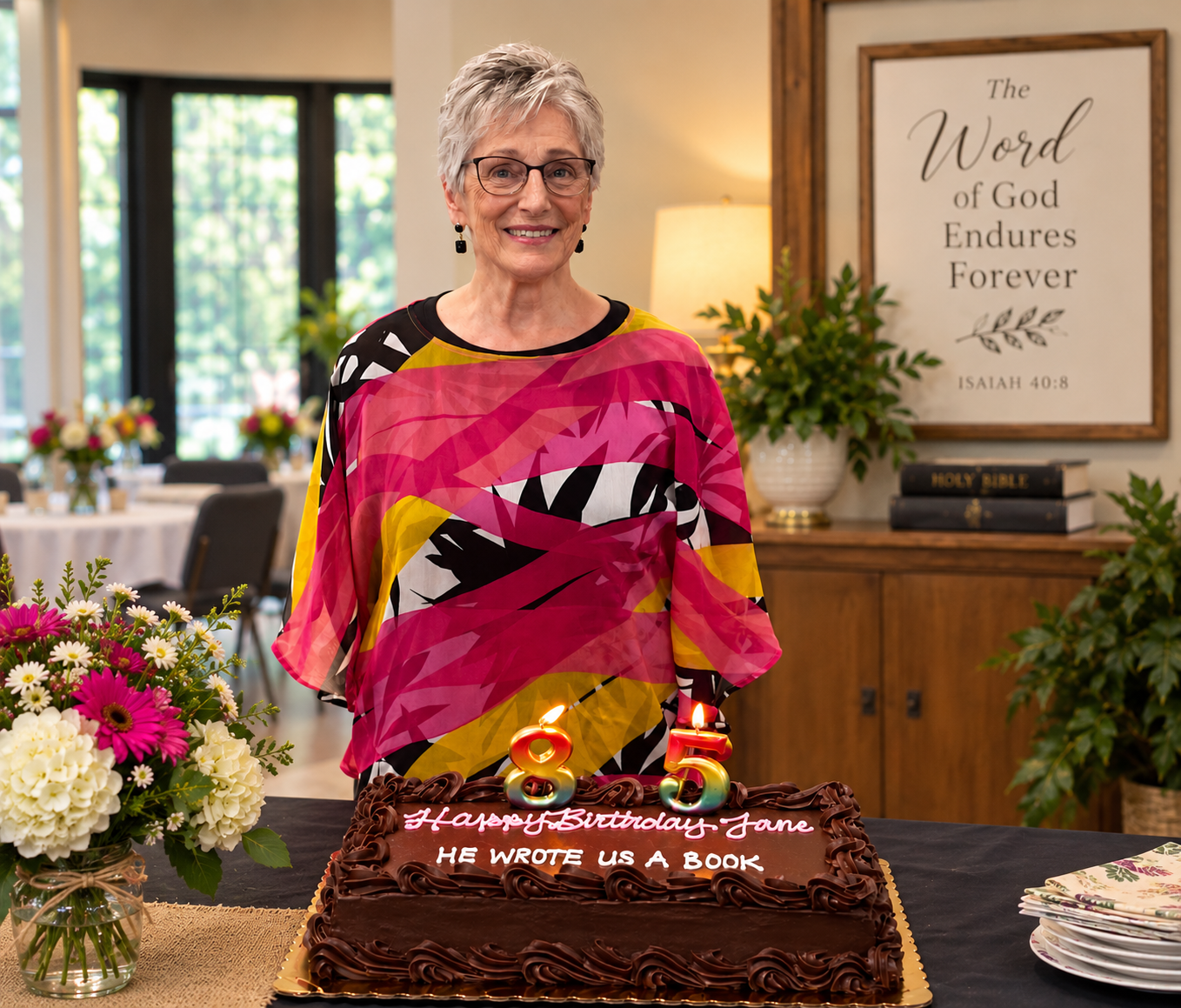
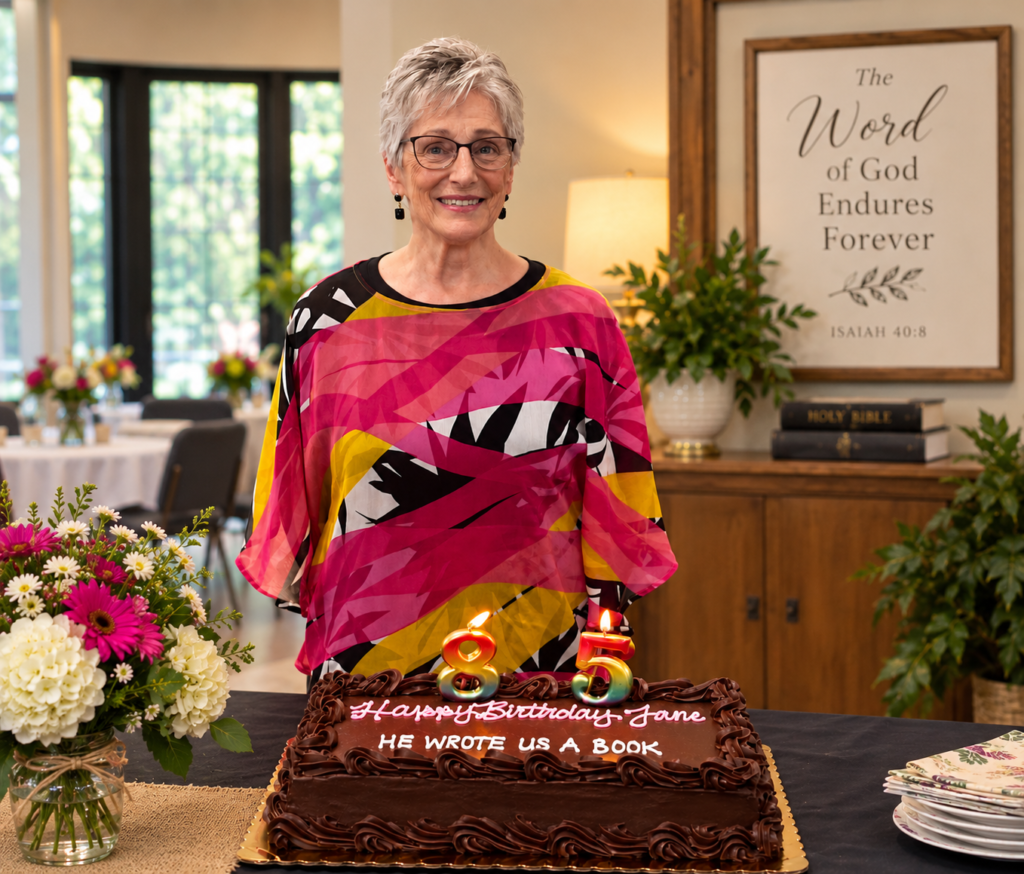
    Several years ago, we had the absolute privilege of welcoming a woman into our group who had moved to our area to be near her family. Her name is Jane, but we all call her Mrs. Jane, and she very quickly became one of my spiritual mothers.

    Mrs. Jane has a saying we hear from her almost every week. She doesn’t work it into the conversation just because she likes saying it. Somehow, invariably, we will come to a place in our discussion where she lifts up her Bible and says, in that beautiful deep-South drawl of hers,

    “He wrote us a book. You girls remember? He wrote us a book.”

    And every time she says it, I can almost feel the younger women in the room lean forward.

    Mrs. Jane is eighty-six years old, and when we look at her, we see something we hope to become. Now, if she reads this, she is going to fuss at me and say, “Tina, you know I am not perfect.”

    And I will agree with her. Mrs. Jane is definitely not perfect. None of us are. But she loves God’s Word, and it shows.

    I think that may be why those words mean so much to me when she says them. Mrs. Jane isn’t simply reminding us that we own Bibles. She has spent enough years in the Word for us to see what happens when a woman keeps returning to it.

    She has let Scripture tell her who God is.

    That sounds simple, but it is not a small thing.

    Every one of us has a picture of God in our minds. We may not have built it intentionally, but it is there. Some of it came from Scripture. Some came from people who taught us well. Some came from people who did not. Some of it grew out of childhood, church experiences, disappointment, unanswered prayer, fear, or simply something we heard often enough that we stopped questioning it.

    And whatever picture we carry matters, because we will live in response to the God we believe Him to be.

    That is where Mrs. Jane’s little sentence becomes much more than a sweet saying.

    He wrote us a book.

    God did not leave us to construct Him from our experiences, preferences, or assumptions. He chose to reveal Himself.

    In theology, we call that revelation. But the word simply means that God has made known what we could never discover fully on our own. He is not a God we invent. He is a God who speaks.

    And because He has spoken, I do not have to ask only, “What do I think God is like?”

    I can ask a much better question:

    What has God actually revealed about Himself?

    That question has challenged me more than once, because sometimes what I have always believed and what Scripture actually says are not exactly the same.

    Second Timothy 3:16 tells us that Scripture is God-breathed and that God uses it to teach us, correct us, train us, and equip us. I need all four of those things. I like the teaching part. The correcting part can be less comfortable.

    There have certainly been times when I wanted God’s Word to reassure me more than I wanted it to challenge me. I wanted God to confirm what I had already decided or to fit neatly into what made sense from where I was standing.

    But if God is really God, I should expect Him to be bigger than my categories. And if He has chosen to reveal Himself, then I want to know Him as He actually is—not simply as I have imagined Him to be.

    That is where Scripture keeps bringing me back.

    John begins his Gospel by telling us, “In the beginning was the Word.” Then, a few verses later, the Word becomes flesh and dwells among us.

    God did not merely send us information about Himself.

    He came near.

    And when we open Scripture, we are not simply looking for better principles for living. We are learning the character of the God who has made Himself known most fully in Jesus.

    I think that is one reason I care so deeply about women learning to study the Bible for themselves.

    Yes, context matters. Interpretation matters. Good teachers and good resources matter. We should be humble enough to learn from people who have studied more than we have. But God’s Word was not given only to scholars. It was given to His people.

    That means women like us can open it on a Wednesday night around a table. We can open it early in the morning with a cup of coffee. We can open it when life is going beautifully and when we have no idea what God is doing.

    And over time, something happens.

    Not because the Bible changes.

    Because we do.

    Psalm 119 calls God’s Word a lamp to our feet and a light to our path. I have always loved that image. A lamp usually doesn’t show you the whole road. It gives you enough light to take the next step.

    That has certainly been true in my life. There have been mornings when Scripture has corrected a fear I woke up carrying. Other times it has exposed a motive I would rather not have seen. Sometimes it has simply reminded me that what I feel very strongly is not necessarily what is true.

    And sometimes a familiar verse has met me in a new season so personally that I wonder how I missed it before.

    The verse hadn’t changed.
    God hadn’t changed.
    But perhaps I was finally in a place to hear it differently.

    Hebrews 4:12 tells us that the Word of God is living and active. I don’t think that means we should go searching for secret meanings that change with our circumstances. I think it means that the living God continues to use His unchanging Word to work in living people.

    People like Mrs. Jane. People like me. People like you.

    So I keep coming back to it because I forget, because the world gets loud, because my feelings can be very convincing, and because sometimes I would rather God agree with me than correct me. In His kindness, He did not leave me to guess who He is.

    Mrs. Jane is right.

    He wrote us a book.

    Maybe before we worry about whether we have the perfect study Bible, the perfect plan, enough time, or enough knowledge, we begin there.

    God has spoken.

    Let’s choose to open the amazing gift of His Word and listen!